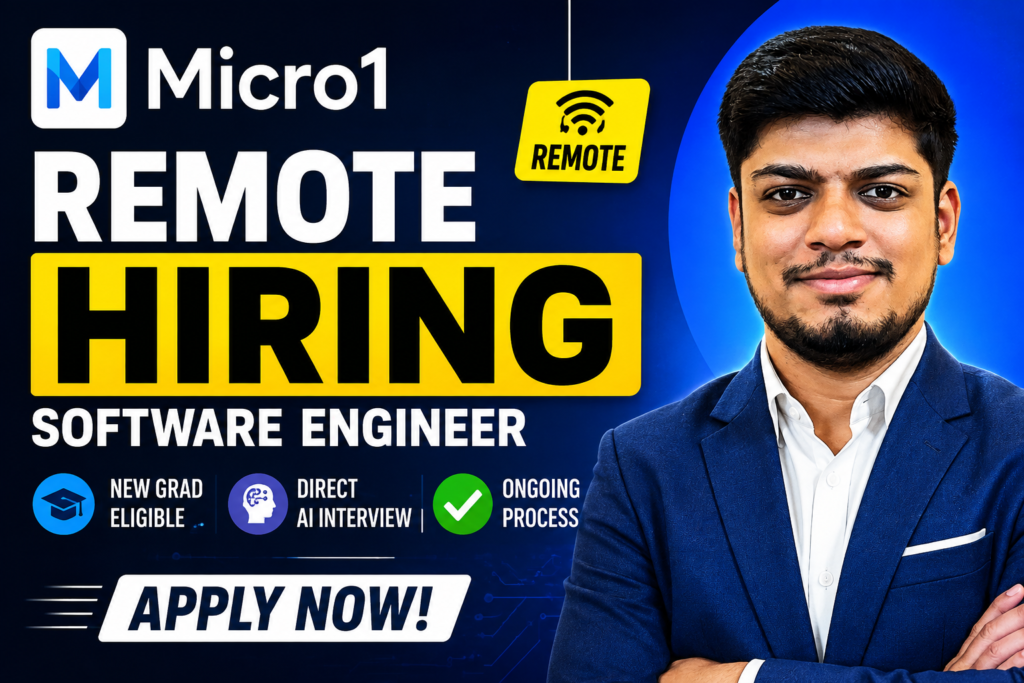
micro1 Is Hiring Software Engineers, New Grad (Remote, Global)
 Overview
 Overview
Fully remote, new-grad-friendly, fullstack role at a company working directly on training data for frontier AI models — this is exactly the kind of listing that gets shared around without anyone actually reading the fine print. We did, and there’s a genuinely important detail buried in this one that most reposts will skip entirely: the compensation numbers don’t match each other, and you should know that before you apply.
Micro1 Hiring Details:
 Micro1 Hiring Details:
- Company: micro1
- Role: Software Engineer, New Grad
- Team: Core team
- Location: Remote (Global)
- Employment Type: Full-time
✅First, What Does micro1 Actually Do?
This isn’t your typical SaaS or e-commerce company, so it’s worth understanding before anything else. micro1 describes itself as an AI data lab — meaning their core business is working with subject-matter experts across fields like finance, healthcare, and STEM engineering to produce high-quality training data, evaluations, and feedback loops that improve how frontier AI models actually learn and reason. In simpler terms: while everyone talks about the AI models themselves, companies like micro1 sit one layer underneath, building the actual data infrastructure that makes those models better.
They also mention using an “AI recruiter” to identify and vet talent at scale — worth flagging, since the listing itself later confirms this: micro1’s hiring process uses AI tools to assist in candidate screening. If you apply, don’t be surprised if part of your evaluation involves AI-assisted assessment rather than purely human review at every stage.
✅The Compensation Discrepancy You Need to Know About
Here’s the detail we think deserves the most attention in this entire listing. At the top of the posting, the compensation is listed as $180K–$250K/year. But further down, in the formal “Compensation & Benefits Notice” section, it states the actual national pay range is $110,000–$150,000 USD base salary, with equity and performance-based bonuses on top.
That’s a significant gap between the two figures — not a rounding difference, a genuinely different range. Our honest read: the $180K-$250K figure at the top is very likely a broader indicator (possibly total compensation including equity/bonus at a senior level, or an internal band that spans multiple experience levels), while the $110K-$150K figure is the actual, formally stated base salary range for this specific new-grad position, since it’s explicitly labeled as the binding compensation notice.
Our advice: don’t anchor your expectations on the top-line number. Go into any conversation with micro1 assuming the base salary is in the $110K-$150K range, and treat anything above that as a pleasant surprise rather than an expectation. If salary transparency matters to you, this is exactly the kind of discrepancy worth asking about directly and early in the interview process, rather than discovering it after you’ve already invested time in multiple interview rounds.
✅What Makes This Listing Genuinely Attractive Despite That
Even at the more conservative $110K-$150K figure, this is a strong offer for a new-grad remote role — especially paired with equity, performance bonuses, up to 100% health insurance premium reimbursement, and a 401(k) match. For context, that base range is competitive with or above many new-grad offers at established tech companies, and remote-first roles at this level (rather than remote roles that are really just “work from home but tied to a specific US office/team”) are still relatively uncommon for entry-level engineers.
CGI Hiring Freshers: Check Here
Metlife Freshers Hiring: Check Here
L&T GenAI Freshers Hiring: Check Here
Cornerstone Hiring Freshers : Check Here
Latest Off-Campus Jobs: Check Here
✅What the Role Actually Involves
This is a genuine fullstack role, not a narrow frontend-only or backend-only position, and the responsibilities suggest real ownership rather than pure task execution:
- Contributing to end-to-end fullstack systems that power internal workflows and platform capabilities — not isolated feature work, but systems that matter to how the company actually operates
- Building backend services and APIs while explicitly being expected to learn scalable engineering practices along the way — a signal that mentorship and growth are baked into the role’s framing, not just implied
- Developing frontend interfaces for both internal teams and end users — so you’d get exposure to both internal tooling UX and customer-facing product work
- Data modeling and database optimization, including schema design — genuinely valuable, often-overlooked skill that a lot of fresher roles don’t expose you to directly
- Working cross-functionally with product, operations, and design — useful exposure to how engineering decisions connect to broader business functions
- Troubleshooting production issues and learning to build observable, resilient systems — this phrase specifically suggests exposure to monitoring, logging, and reliability practices, which most fresher roles don’t explicitly teach
The line about developing “sound engineering judgment by making thoughtful tradeoffs between speed, scalability, and maintainability” is worth noting too — it signals that this role expects you to grow into making real architectural decisions, not just implement what you’re told, which is a genuinely valuable growth trajectory if you’re early in your career.
✅The Tech Stack, and What to Actually Prepare
The listing is fairly specific about required skills, which makes prep easier:
Required:
- Strong JavaScript and/or TypeScript fundamentals
- React (or a similar frontend framework)
- Node.js (NestJS specifically called out as a plus — worth a quick look if you haven’t used it)
- PostgreSQL and relational data modeling principles
- REST APIs and how distributed systems communicate
- Git and standard development workflows
Preferred (good to have, not required):
- Cloud platform exposure — AWS, GCP, or Azure
- CI/CD and deployment pipeline familiarity
- Modern architecture exposure — microservices, serverless, or event-driven systems
- Genuine interest in AI-powered products or data-intensive applications
- Hackathon, open-source, or startup project experience
If you’re prepping specifically for this role, prioritize being genuinely solid in React + Node.js + PostgreSQL together — being able to describe a project where you built and connected all three (even a personal project) will carry more weight than surface-level familiarity with a longer list of “preferred” technologies.
✅Who Should Actually Apply
The qualifications are realistic for genuine new grads: a CS/related degree (or graduating soon), and internship, co-op, research, or meaningful personal/project experience — notably, this explicitly allows personal projects to count as qualifying experience, not just formal internships. If you’ve built and deployed something real on your own, even without a formal internship on your resume, you’re not automatically excluded here.
Given that the role touches AI-adjacent products and workflows (given micro1’s core business), showing genuine interest in AI-powered products or workflow automation — even just curiosity, not expertise — is explicitly called out as a preferred trait, and worth mentioning authentically if it’s true for you.
✅A Few Honest Things to Weigh
- This is a fully remote, likely US-anchored compensation structure — the pay range is quoted in USD and framed as a “national” (likely US) pay range. If you’re applying from outside the US, clarify directly how compensation, taxes, and legal employment structure would actually work for your location before assuming the stated range applies to you as-is.
- AI-assisted screening is explicitly used in their hiring process. This isn’t necessarily a downside, but it does mean your application and early responses may be evaluated by AI tools before a human sees them — so clear, specific, well-structured responses (rather than vague or generic ones) likely matter even more than usual.
- The compensation ambiguity is a real yellow flag worth clarifying early, not a dealbreaker, but definitely something to raise directly and get a clear answer on before you get emotionally invested in the higher figure.
✅Quick Questions You're Probably Asking
- Is this actually a good first job, or is it a “growth stock” pitch dressed up as a listing? Based on the responsibilities alone, it reads as genuine — end-to-end ownership, cross-functional work, and explicit mentions of learning production reliability practices aren’t things companies usually fabricate in a JD, since they’d have to actually deliver on them once you’re hired and comparing notes with other new hires. The fact that personal projects count as qualifying experience also suggests they’re genuinely trying to widen the funnel to strong candidates rather than gatekeeping on pedigree alone.
- Should I worry about working at an “AI data lab” instead of a traditional product company? Not necessarily — if anything, this is a reasonable way to get exposure to how AI systems are actually built and evaluated behind the scenes, which is a genuinely different (and arguably more foundational) perspective than working on a typical consumer-facing product. If your longer-term interest is in AI/ML-adjacent engineering roles, this kind of exposure — even from the platform/infrastructure side rather than the model-building side — is a reasonable stepping stone.
- What if I don’t hear back, or the AI screening feels impersonal? Since AI tools are explicitly used to assist screening, it’s worth assuming your first-pass application matters more than it might at a company relying purely on manual resume review. Don’t submit a rushed, generic resume or cover letter — be specific about actual projects, technologies used, and outcomes, since vague language is exactly what gets filtered out by automated screening layers.
📍How to Apply
Apply through micro1’s official careers page for the Software Engineer, New Grad role (remote). AI-assisted screening means your application materials should be specific, clearly written, and actually represent real projects or experience, not just generic phrasing.
About LatestOffCampusJobs:
 About LatestOffCampusJobs:
TraceLink Freshers Hiring: Check Here
CGI Hiring Freshers: Check Here
Metlife Freshers Hiring: Check Here
L&T GenAI Freshers Hiring: Check Here
Cornerstone Hiring Freshers : Check Here
Latest Off-Campus Jobs: Check Here
📢 Stay Updated
Join 300K+ on YouTube for instant job alerts and placement tips