The Top 50 Questions and Answers for New HR Interviews (2026)
 Overview:
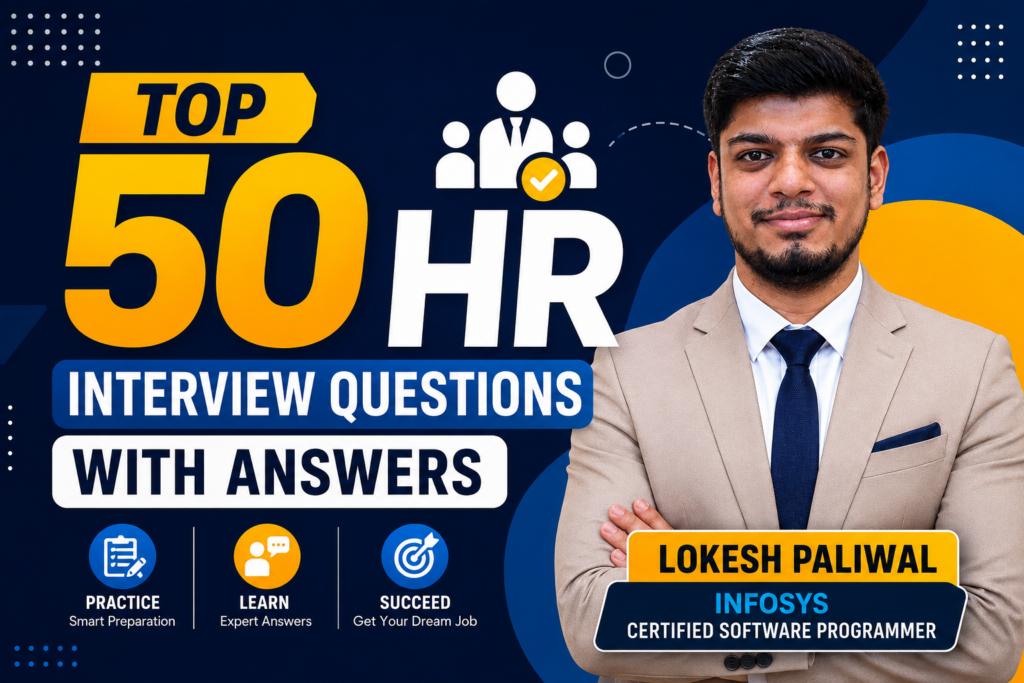
The HR interview is the round where companies decide whether you’re the right fit — not just for the job, but for their team and culture. Unlike technical rounds, this one tests your communication, confidence, and attitude. The encouraging part is that HR questions are predictable, and with good preparation you can answer them smoothly. Below are the top 50 HR interview questions with sample answers and tips. Treat these answers as a guide — always personalize them to your own background so they sound natural.
✅ Questions About Yourself
1. Tell me about yourself.
“I recently received my degree in computer science, and I have a keen interest in software development. During college I built a few projects using Java and worked on team assignments that improved my collaboration skills. I’m now looking for a role where I can apply my technical skills and keep learning.”
2. What are your strengths?
“My biggest strengths are my willingness to learn quickly and my consistency. Once I commit to a task, I make sure to complete it well, even if it takes extra effort.”
3. What is your weakness?
“I sometimes spend too much time perfecting small details. I’ve been working on this by setting time limits for tasks so I stay efficient.”
4. How would others describe you?
“My companions would portray me as solid and calm beneath weight, and my teachers frequently famous that I inquire mindful questions.”
5. What motivates you?
“Solving problems motivates me. The satisfaction of figuring out something difficult pushes me to keep improving.”
6. What are your hobbies?
“I enjoy reading tech blogs and playing chess, which helps me think strategically.”
7. How do you handle pressure?
“I break big tasks into smaller steps and focus on one at a time, which keeps me calm and organized.”
8. Do you prefer teamwork or working alone?
“I’m comfortable with both, but I enjoy teamwork because different ideas often lead to better solutions.”
9. What is your biggest achievement?
“Leading my final-year project team and delivering it on time despite a tight schedule is something I’m proud of.”
10. Tell me about a failure.
“I underestimated a deadline once and had to scramble to finish on time. After that I got a lot better at planning my work, and now I always leave myself some buffer.”
✅ Questions About the Company and Role
11. What do you know about our company?
“I know you’re a leader in your field, with a strong presence in software services and a focus on client satisfaction. I also read about your recent expansion.”
12. Why this role?
“This role matches my skills in development and offers exactly the kind of hands-on learning I’m looking for as a fresher.”
13. Why should we hire you?
“I bring a strong willingness to learn, solid technical fundamentals, and a positive attitude. I’m confident I can grow into a valuable team member quickly.”
14. How can you contribute to our company?
I can bring new energy, show strong commitment, and learn quickly, which allows me to take on tasks and help the team succeed.
15. Who are our competitors?
I know about some big companies in your field, but I really wanted to work with you because of the good reputation you have for being a supportive place to work.
16. What do you like about our products?
“I find your products user-friendly and well-designed, which shows you genuinely focus on customer needs.”
17. Where is this industry heading?
“The industry is moving rapidly toward automation and AI-driven tools, which makes it an exciting time to enter the field.”
18. What do you expect from this job?
I hope to have the opportunity to learn, help out, and develop, while working with a team that cares about doing things well.
19. What are your long-term goals?
“In the long term, I’d like to become an expert in my field and grow into a leadership position.”
20. Are you willing to relocate?
“Yes, I’m open to relocating for the right opportunity and to grow my career.”
21. Are you okay with night shifts?
“Yes, I’m flexible with shifts as long as it supports the team’s needs.”
22. How long will you stay with us?
“As long as I’m learning and growing, I’d be happy to build a long-term career here.”
23. What work environment do you prefer?
“I prefer a collaborative environment where people support each other and there’s room to learn.”
24. Will you study further while working?
“If I do, it would only be something that adds value to my work, and I’d ensure it never affects my job.”
25. What role do you hope to develop in the future?
“I’d like to grow into a senior technical role where I can solve complex problems and guide others.”
26. How do you define success?
“To me, success means continuous growth — improving my skills while creating real value for my team.”
✅ Behavioural and Situational Questions
For these, use the STAR method — explain the Situation, then the Task, followed by the Action you took, and finally the Result you achieved.
27. Can you share an example of when you collaborated with a group of people on a project?
In my final project, I organized the work so that four team members could carry out their tasks. By splitting the tasks according to everyone’s best skills, we completed the work earlier than planned.
28. Describe a conflict you resolved.
“Two teammates disagreed on an approach. I recommended we test both ideas quickly, and the data helped us decide calmly.
29. Give an example of leadership.
I signed up to lead a college event team, gave everyone their tasks, and kept things moving so the event ended up being a success.
30. Tell me about a missed deadline.
“I once misjudged a task’s difficulty. I let my team know early on, asked for support, and we finished it with very little delay. I learned to communicate sooner.”
31. How do you handle criticism?
“I see criticism as feedback. I pay close attention, say thanks to the person, and keep working on getting better.
32. Describe a difficult problem you solved.
There was an issue with my project that caused the app to crash repeatedly. I checked each part carefully and eventually found a small mistake in the logic.
33. A time you learned something quickly.
I needed to learn a new framework within a week for a project. I followed tutorials and practiced, and I finished the feature as planned.
34. How do you deal with disagreements with a teammate?
I first hear out their opinion, then share mine in a respectful way, and I keep my focus on what’s best for the project instead of trying to win the argument.
35. A goal you set and achieved.
I decided to work on getting faster at coding and practiced every day for a whole month, which really helped me get better at it.
36. A time you took initiative.
I saw that our project didn’t have any documentation, so I made some on my own without waiting for instructions, and it really helped everyone on the team.
✅ Practical and Closing Questions
37. What is your expected salary?
As a new graduate, I’m willing to accept a reasonable salary that matches the job role and what is standard in the industry. I’m focusing more on learning and growing right now.
38. When can you join?
I can start right away, or within the notice period if needed.
39. Do you have other offers?
I’m looking at a few possibilities, but this job is my favorite because it has a lot of opportunities to grow.
40. Are you okay with a service agreement?
Yes, I’m okay with fair conditions because I want to work here for a long time.
41. How do you stay updated with skills?
I read about technology on blogs, take classes online, and keep practicing to make sure my abilities stay strong.
42. What if you disagree with your manager?
I would express my opinion politely along with the reasons behind it, but I will also respect the final decision and agree to follow it.
43. Why choose you over an experienced candidate?
I come up with fresh ideas, can adapt fast, and am really eager to prove what I can do, often picking up new methods quickly.
44. Do you have any questions for us?
Can you tell me what kind of learning and development opportunities a new person can expect in this job?
45. Are you a planner or spontaneous?
Can you tell me what kind of learning and development opportunities a new person can expect in this job?
46. Why are you a good match for our company’s culture?
From what I’ve learned, your culture really values learning and teamwork, which is exactly how I like to work and grow.
47. What’s your biggest strength? “I’d say my biggest strength is staying calm under pressure. When the workload piles up or a deadline is close, I don’t panic — I just break things down and tackle them one at a time. My team knows they can count on me when things get hectic.”
48. What’s your biggest weakness? “I used to struggle with saying no, so I’d take on too much at once. Over time I’ve learned when to ask for help and when to delegate, and honestly my work has gotten better because of it.”
49. How do you handle pressure? “The first thing I do is list out everything by priority, so I know what actually needs my attention first. Then I work through it step by step. Breaking it down keeps the stress low and helps me deliver on time.”
50.Where do you think you will be in five years ? “In five years I’d like to be someone the team relies on — more experienced, handling bigger responsibilities, and maybe mentoring a few newer people. Mostly I want to keep growing and getting better at what I do.”
Want a few more, or answers in a different tone?
 Final Tips & Conclusion
Dress in a tidy way, get there when it’s time, and say hello to the interviewer with a friendly smile. Always be truthful in your answers — interviewers can tell when responses sound rehearsed or too big. Practice speaking out loud before the interview so your answers feel natural and real, and keep a positive attitude throughout the whole process. Always keep a positive attitude when talking about your college, professors, or any previous experiences.
The HR interview is your chance to demonstrate that you are confident, positive, and a good match for the company’s culture. By creating these 50 questions and building your answers from your personal experiences, you take away a lot of the fear from the process. Don’t try to remember exactly what to say — focus on understanding what each question is really about and answer in a clear and truthful way. Practice often, enter the interview with confidence, and you’ll be prepared to turn your interview into your first job offer. All the best!
✅ About the Author:
Lokesh Bagora
- Founder, Online Learning
- 330K+ YouTube Subscribers
- Career Guidance Content Creator
- Running a website dedicated to helping freshers and job seekers
About LatestOffCampusJobs:
📢 Stay Updated
Join 300K+ on YouTube for instant job alerts and placement tips